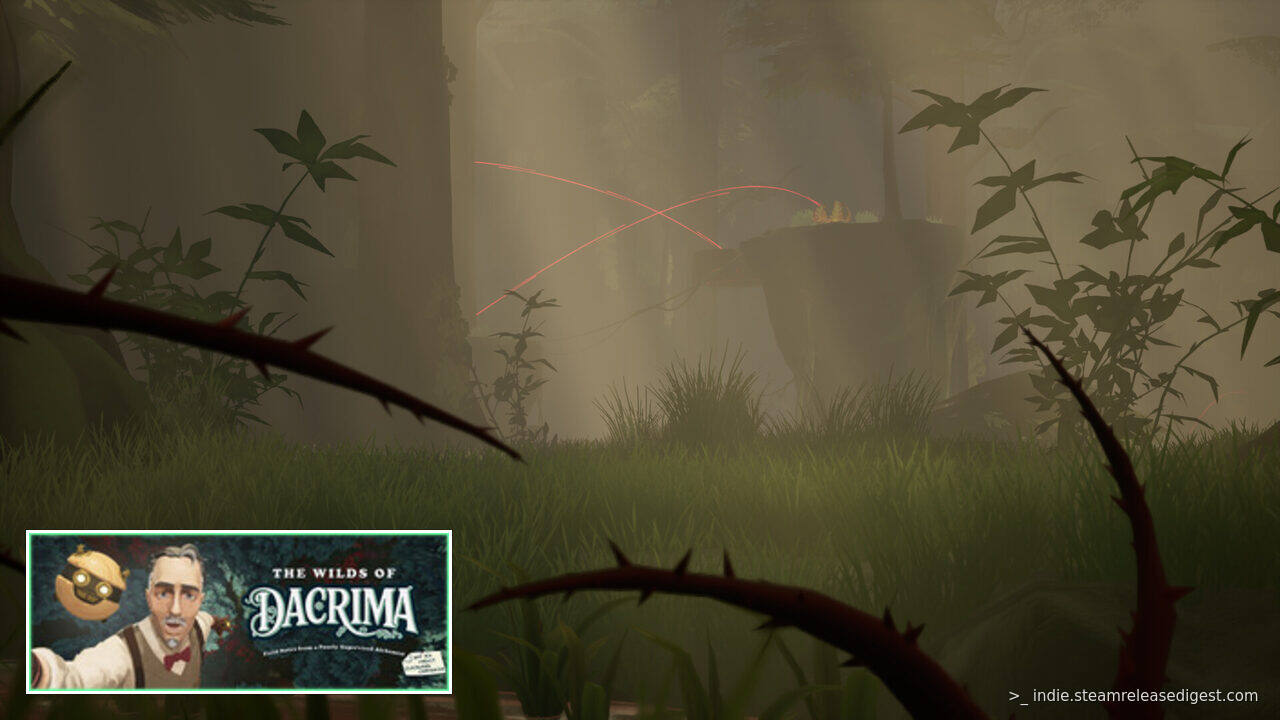
Let’s set the scene: You are Professor Edric Tayte, a weathered alchemist approaching seventy years of age, standing before a rocky ledge that is just slightly too high for your aching knees. Instead of searching for a ramp, you look down at your unauthorized, blocky robot sidekick, L-P1N. With a metallic grunt, you deploy L-P1N as a makeshift step-stool, hop directly onto his flat metal head, and hoist yourself up to harvest a glowing, bizarre piece of alien flora. This is the daily routine in Antler Studios’ first-person adventure, where the pursuit of science is as much about managing your aging joints as it is about finding a cure for a catastrophic plague.
Brewing a Cure in a Beautiful, Dying World
The heart of the game lies in exploring the vibrant, stylized environments of Dacrima to find a cure for “The Great Rot,” a plague that has devastated the local ecosystem. To do this, you must wander through forests and caves, cataloging bizarre plants, absurd animals, and miraculous minerals using a scanner that pieces together the world’s lore. Gathering these ingredients isn’t just for show; you combine them to brew potent potions that grant Edric new traversal abilities and status-altering effects.
It is a first-person puzzle-platformer structured around a cozy, exploration-heavy loop. As you unlock new concoctions, previously unreachable areas of the forest open up, transforming Dacrima from a seemingly open landscape into a carefully guided puzzle box. Rather than leaving you entirely to your own devices, the game does a solid job of gently steering you toward your next objective, ensuring you don’t get entirely lost in the wilderness while hunting for materials.

What Players Love: Banter, Beauty, and Botanicals
Steam reviewers have responded warmly to this oddball science expedition, which currently holds a highly positive reception among its player base. Players frequently praise the game’s whimsical atmosphere and its surprisingly rich, cozy narrative. The dynamic between the curmudgeonly Edric and the unruly L-P1N is elevated by excellent voice acting, making their constant banter a highlight rather than a nuisance.
The core loop of scanning and collecting is highly addictive. Several players note that they found themselves hoarding far more materials than they actually needed, simply because wandering through the colorful, stylized landscapes felt so relaxing. The puzzles hit a sweet spot—engaging enough to require some genuine thought, but never so frustrating that they shatter the game’s inherently cozy, low-stress vibe.
The Rough Edges: Physics, Bugs, and Gating Issues
However, the “poorly supervised” subtitle applies to the game’s technical state as much as its protagonist. Players report that the controls and movement can feel noticeably unpolished. Basic mechanics like swimming and general navigation are described as glitchy and slippery, and a prominent camera wobble has proved polarizing for those sensitive to motion. Additionally, players have expressed a desire for basic quality-of-life improvements, such as larger text sizes for better accessibility and fewer repetitive voice lines.
More pressingly, the game’s level progression can occasionally break its own rules. One player noted falling into a challenge area called “the Pit” without the proper brewing skills unlocked, forcing them to glitch-jump their way out to avoid a permanent softlock. Others have run into more severe, progression-blocking bugs, such as a glitch during the “Ruby Ruby” quest that prevented them from moving forward entirely, alongside sporadic game crashes. Finally, those hoping for a deep, complex potion-making simulator might be disappointed; the brewing is largely a streamlined means to advance the guided, story-driven campaign, rather than a free-form crafting system.
The Verdict
Ultimately, this game is a delightful fit for players who value character, atmosphere, and light puzzle-platforming over mechanical perfection. If you enjoy cozy, narrative-driven exploration games but don’t mind a healthy dose of indie jank, Professor Tayte’s journal is well worth opening. Just be prepared to occasionally fight the physics engine—and maybe save your game often in case the bugs catch up to you.
Key Facts
- Developer: Antler Studios
- Publisher: Antler Studios
- Release Date: May 12, 2026
- Price: $19.99