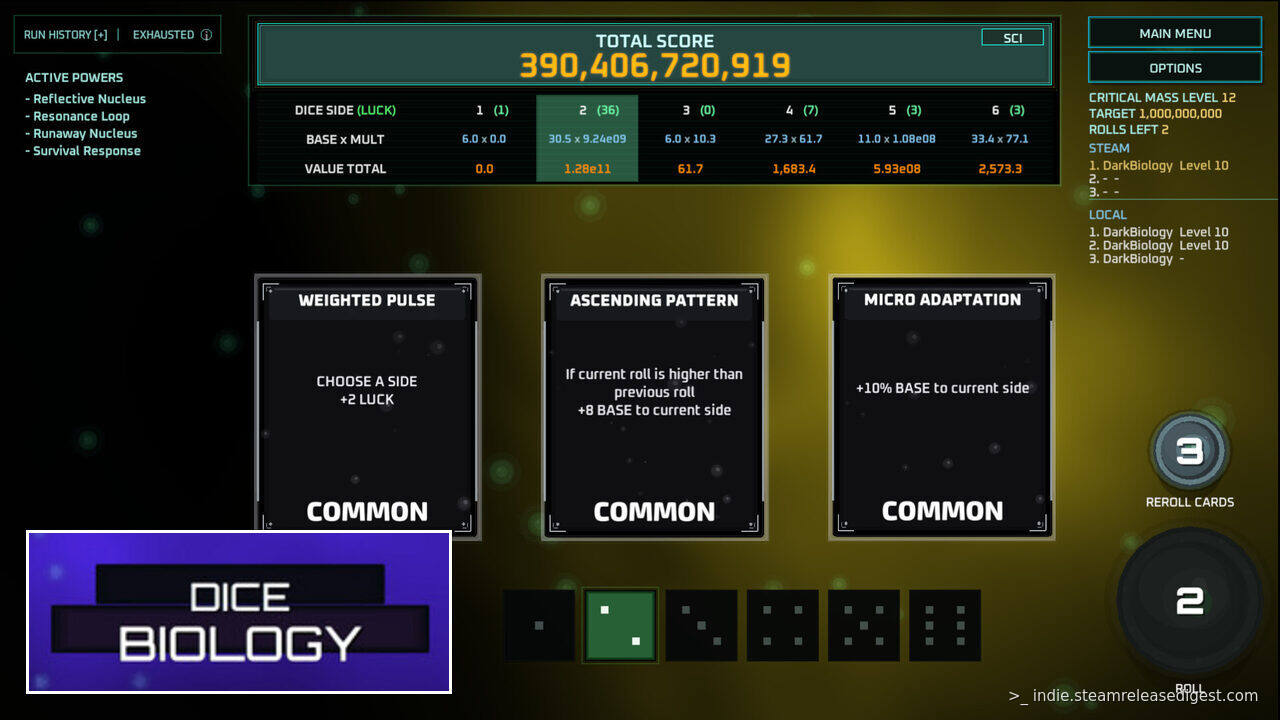
In Dice Biology, a single face of a standard six-sided die isn’t a fixed destiny; it’s an evolving canvas. You might start a run rolling standard ones and twos, but twenty minutes later, your third die face has been mutated into a monstrous multiplier engine that triggers a cascade of compounding points every time it lands face-up. It is a game about seizing control of random chance, one surgical upgrade at a time.
Shaping the Sides of Chance
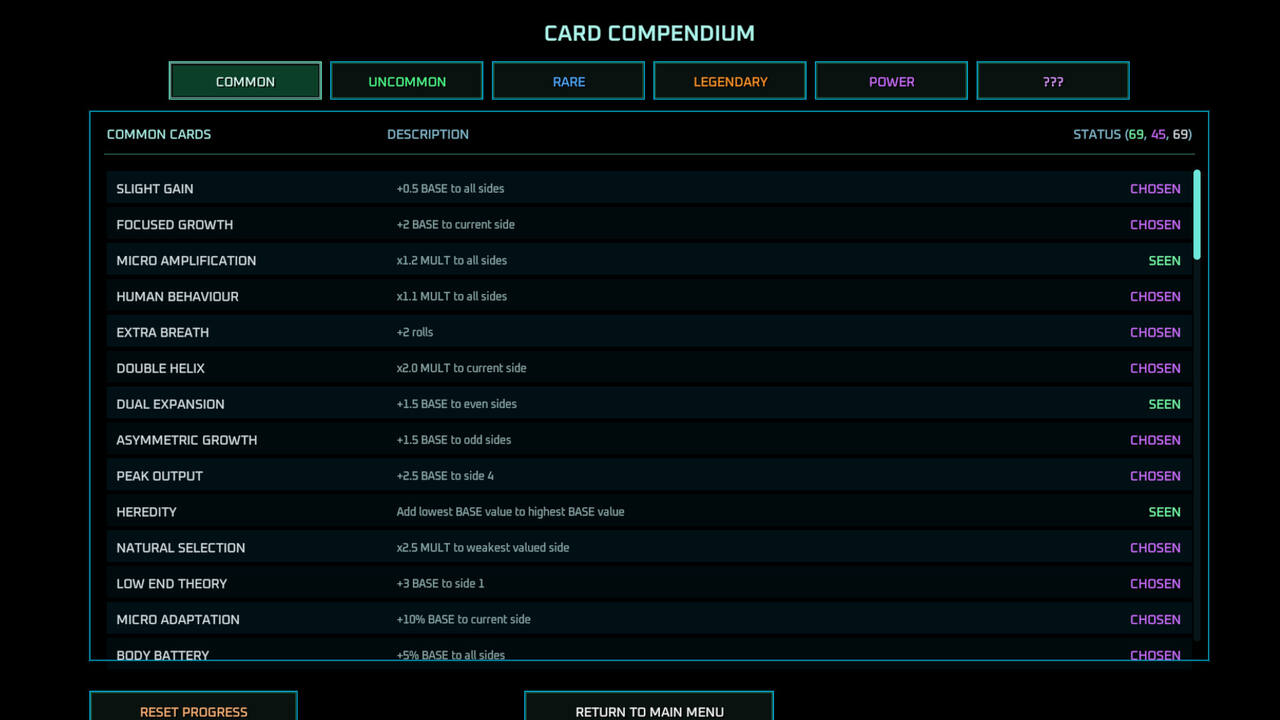
At its core, Dice Biology is a roguelike dice-builder focused on scaling and statistical optimization. Instead of building a deck of cards, you build a single die. You start with a basic six-sided die, but through over 350 mutation cards, you permanently reshape its faces over the course of a run. Every card choice you make injects new properties into your rolls, allowing you to increase base score values, stack multipliers, or boost your Luck stat to manipulate how often your best faces turn up.
The strategy lies in deciding how to allocate these mutations. You can build a balanced die where every side offers a reliable, moderate payout, or you can go all-in on a high-risk, high-reward strategy. In the latter, you sacrifice weaker sides to supercharge a single face, effectively turning your die into a volatile jackpot machine where one lucky roll can instantly catapult your score into the stratosphere. Because the game features full controller support, a mouse-only option, and requires no timed inputs, you are free to sit back and calculate your next move without any physical pressure.
An Array of Statistical Puzzles
This core loop of mutating dice faces is spread across several distinct game modes that test your build from different angles. Classic Mode is a straightforward race to the top of the global Steam leaderboards, but things get weirder from there. In Critical Mass, you face a tense survival challenge where you must hit a brand-new target score every three rolls or watch your run end. Power of Two changes your starting conditions entirely, giving you two permanent power-ups to build your strategy around from the very first roll.
For players who want to flip the game’s logic on its head, Entropy Mode tasks you with doing the exact opposite of the norm: building a die that scores as poorly as possible to win. Finally, 100 Billion Mode acts as the ultimate optimization puzzle, challenging you to hit an astronomically high score target in the absolute fewest rolls possible. This variety keeps the simple act of rolling a die from feeling repetitive, turning each mode into a unique mechanical riddle.
What Players Love (And Where It Grates)
With an 80% positive user rating on Steam, Dice Biology has quickly earned a reputation among indie fans as a highly addictive “number goes brrr” experience. Players frequently compare the game’s dopamine loop to Balatro, noting that watching a simple, low-stakes run quickly spiral into crazy, large-scale synergies is incredibly satisfying. The depth of the mutation system and the drive to climb the Steam leaderboards give the game a strong “just one more run” pull that belies its simple presentation.
However, the game is not without its rough edges. The most pressing issue raised by the community is regional availability, with some players reporting that the game is blocked or non-functional in their specific regions. Additionally, because the long-term replayability relies heavily on competitive high scores, some users have expressed skepticism about the legitimacy of the top leaderboard spots, hoping for robust developer moderation to keep the competition fair. It is also worth noting that this is a streamlined, low-budget title—if you are looking for flash animations or a rich narrative, you will not find them here. The focus is entirely on numbers, cards, and probability math.
The Verdict
Dice Biology is a clever, hyper-focused puzzle game designed for players who love systems-driven gameplay. If you enjoy the thrill of discovering broken mechanical synergies, chasing high scores, or simply watching numbers grow exponentially, this is an incredibly easy recommendation—especially at its modest $4.99 price point. It’s a quiet, cerebral experience that respects your time and lets you break the laws of probability at your own pace.
Key Facts
- Developer: DarkBiology
- Publisher: Resensitized Games
- Release Date: May 12, 2026
- Price: $4.99