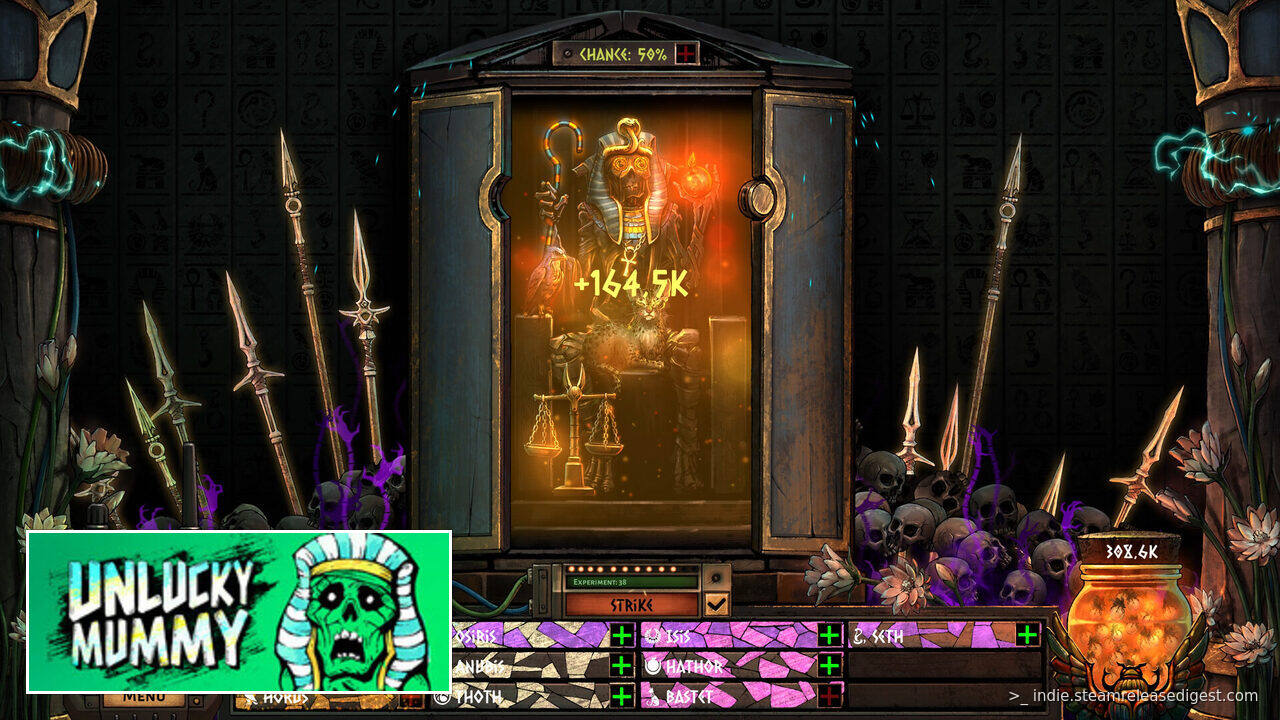
One player called Unlucky Mummy an “awful game” before immediately admitting they couldn’t stop playing it; another described it simply as a test of self-control that they miserably, thankfully failed. This is the central friction of Karaclan’s budget-priced incremental clicker: it is a beautifully wrapped, agonizingly basic simulation of a gambling addiction. It takes the quantum concept of superposition—the idea that a state exists in multiple realities until observed—and weaponizes it into a digital coin flip that will either trigger a rush of endorphins or leave you staring blankly at your screen in disbelief.
The Physics of Frustration
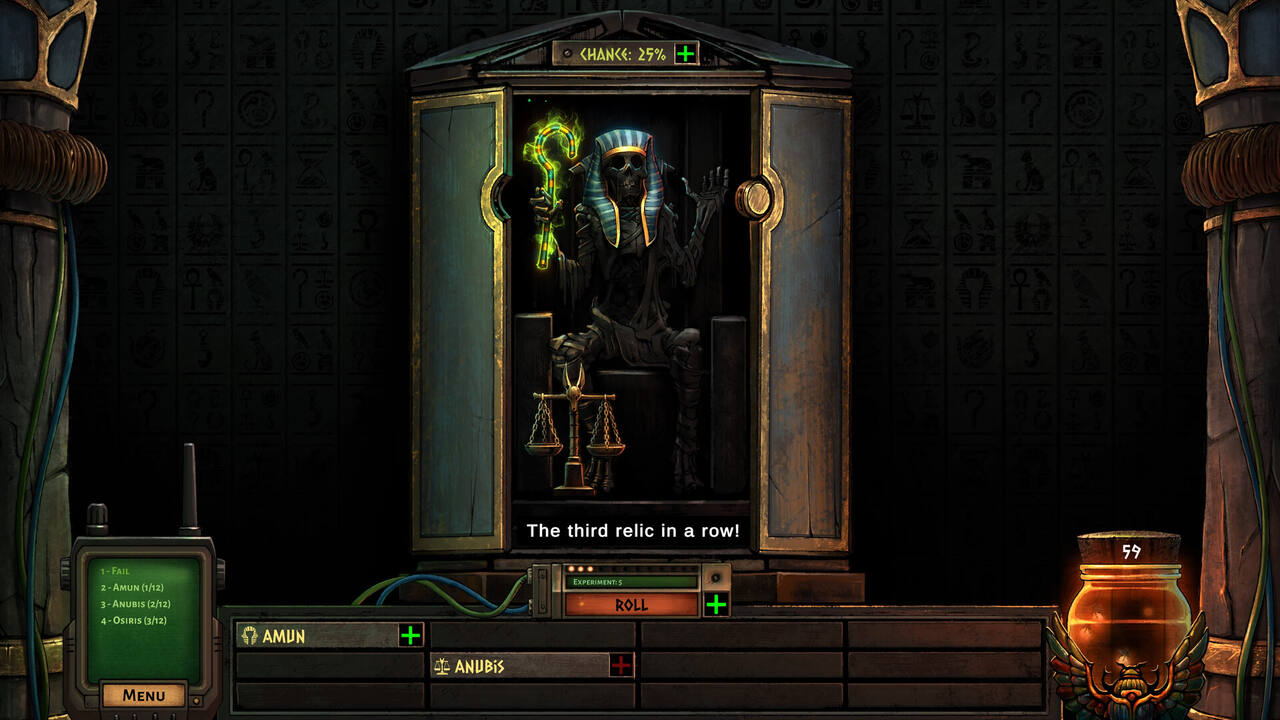
The premise of Unlucky Mummy is stark in its simplicity. Before you stands a sarcophagus containing a mummy and twelve slots for ancient relics of the Egyptian gods. When you click to open the sarcophagus, you have a baseline 25% chance of successfully finding a relic. If you succeed, you get a relic and some golden scarabs. If you fail—which, at the start, you will do three times out of four—the sarcophagus is empty, and every single relic you have collected on this run vanishes instantly, resetting your progress to zero. To beat a run and resurrect the mummy, you must successfully find all twelve relics in a row. At default odds, the mathematical chance of pulling this off is a staggering 1 in 16,777,216.
To tilt the cosmic scales in your favor, you spend those golden scarabs on permanent upgrades. You can increase your baseline success chance, speed up the opening animations, or boost the rewards you get from each successful discovery. Succeeding also unlocks one of six unique narrative endings, each gifting you a permanent “Glyph” that alters the rules for future runs, slowly unraveling a larger story in the process.
What Players Love (and What Drives Them Mad)
Steam reviews reveal a player base caught in a tight loop of aesthetic charm and mechanical irritation. On the positive side, players frequently highlight the game’s surprisingly high production values. The art is striking, the voiceover work is genuinely high-quality, and the animations are excellent. There is also a quiet appreciation for the game’s atmospheric writing and clever pop-culture nods, including a reference to the sci-fi series Dark. For players who get a good run, especially if they unlock a powerful glyph early on—like the Marie Curie glyph—the game quickly transitions from a brutal slog to a satisfying power trip.
But Unlucky Mummy does not hide its rough edges, and its design has drawn some sharp criticism. The primary culprit is the complete lack of automation. Unlike most modern incremental games that eventually let you sit back and watch numbers go up on their own, this game demands manual clicks. Some players find themselves hitting the button over 450 times with very little progression to show for it, describing the loop as a tedious grind that can wear out its welcome in minutes.
Furthermore, the game’s random number generator (RNG) has drawn some suspicious side-eyes. Multiple players have reported bizarre, frustrating streaks of bad luck, such as failing a 94% success rate four times in a row. Because of how the “all-or-nothing” mechanic works, a single streak of bad luck completely wipes your active progress. This frustration is compounded by uneven meta-progression. The Glyphs you unlock are meant to make subsequent runs faster or more interesting, but players note that their balance is highly erratic. Some Glyphs are incredibly powerful, while others feel entirely useless, meaning a new run might actually feel slower and more tedious than your last one depending on what you unlocked.
The Verdict
So, who is Unlucky Mummy actually for? It is certainly not for the idle-game purist looking for complex spreadsheets, deep automation trees, or a passive background experience. This is a game for the hands-on clicker enthusiast who enjoys the raw, high-stakes tension of pure probability. If you can appreciate beautiful artwork, charming animations, and are willing to tolerate the occasional devastating streak of mathematical cruelty, it is a fascinating, bite-sized experiment in risk and reward. Just be prepared to have your patience thoroughly tested by the cold, impartial laws of quantum randomness.
Key Facts
- Developer: Karaclan
- Publisher: Karaclan
- Release Date: Jun 2, 2026
- Price: $2.99