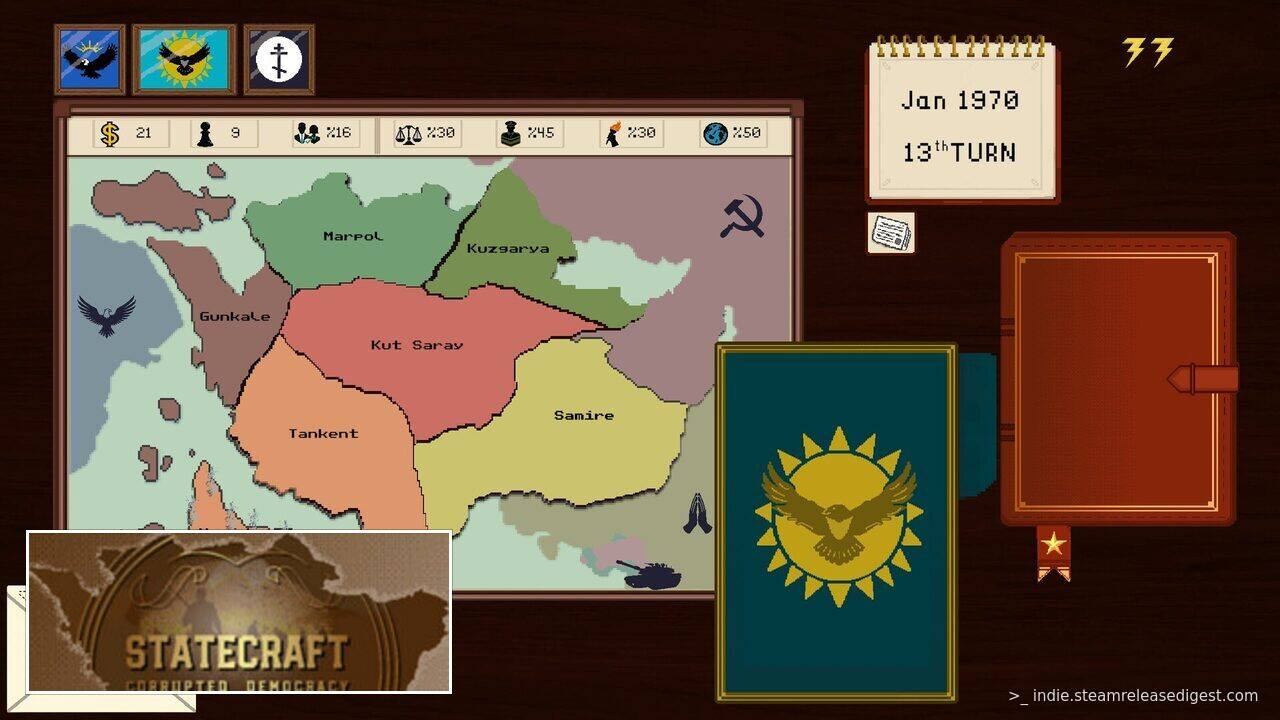
Try to run an honest, clean campaign in Statecraft: Corrupted Democracy, and you will get absolutely pulverized in the polls.
This is not a game about idealistic public service; it is a dark, cynical, and highly condensed simulator where running a political party feels closer to running a mid-century crime syndicate. Set in a fictionalized, volatile country reminiscent of Cold War-era Turkey, the game drops you into a landscape of economic collapse, street violence, and deep social divides. Your goal is simple: win the upcoming election by any means necessary. If you cannot win through the ballot box, the game expects you to tear the ballot box apart, invite a military coup, or ignite a civil war to seize power anyway.
At its heart, Statecraft treats voters not as citizens with dreams, but as demographic numbers to be mathematically manipulated. You scan country data to identify ideological weak points, finding ways to scare liberals, lie to conservatives, or politicize neutral citizens into fanatical partisans. A core pillar of the gameplay is media control. When crises inevitably strike, you do not solve them; you spin them. If a famine occurs on your watch, the newspaper headline system lets you rebrand it as a state-sponsored “diet program.” If you lose an election, you can pivot to dirty diplomacy, form alliances with radical shadow organizations, or burn the democratic system down entirely to establish a socialist dictatorship or a theocracy.
With an 89% positive rating across its early reviews, the game has clearly struck a chord with niche strategy fans, though player feedback highlights a distinct split between what the game promises on paper and how it feels in practice.
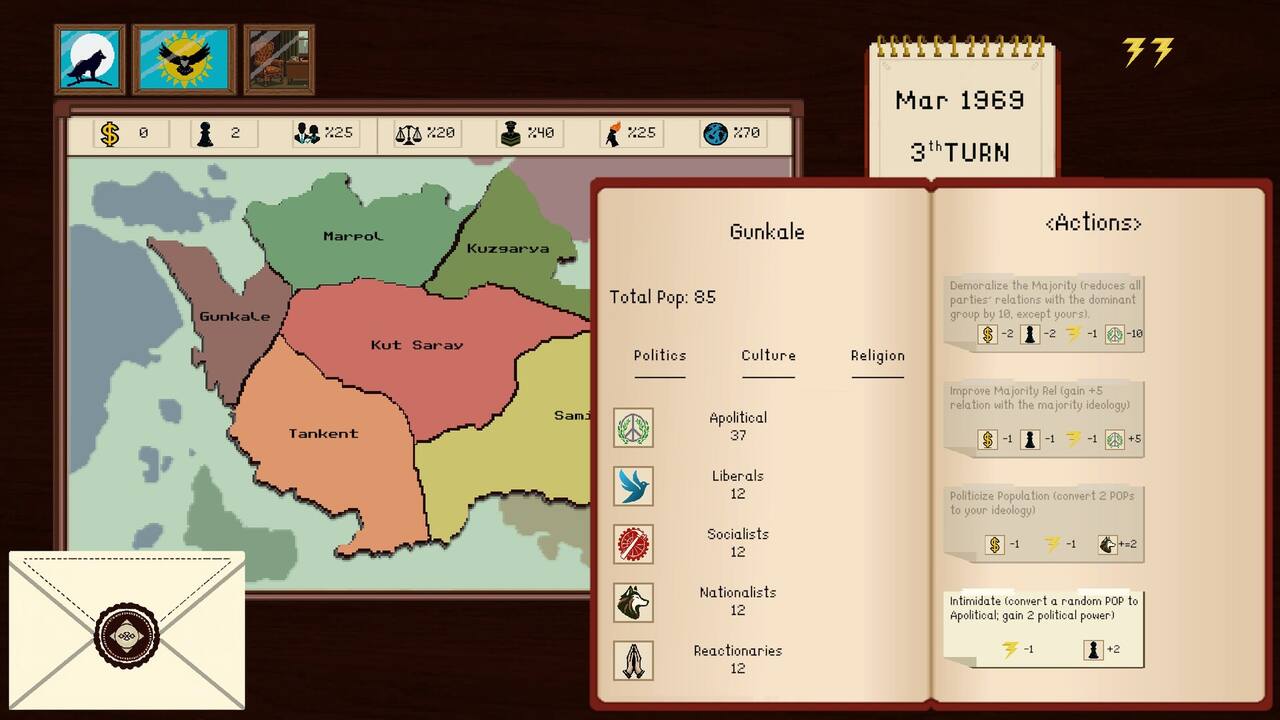
What players love is the game’s brisk pacing and its sharp sense of dark humor. Unlike dense political giants like Suzerain or Democracy, which can require hours of reading and spreadsheet management to understand, Statecraft is highly approachable. Reviewers note that the core mechanics take less than fifteen minutes to grasp. It strips away the bloat of a million sub-systems, offering a streamlined, board game-like flow that makes it easy to run multiple scenarios. The dark, satirical tone successfully captures the chaotic machinations of machine politics, making catastrophic failures just as entertaining as corrupt victories.
However, players are equally vocal about the game’s rough edges. The user interface is currently a major point of frustration. One reviewer pointed out a particularly ironic UX oversight: while the developer thoughtfully added a text-resizing option for accessibility, turning it on causes the text to completely overflow and run out of its designated UI boxes. This clunkiness gives off distinct “single-developer vibes,” requiring players to occasionally fight the interface to enjoy the underlying game.
More critically, players looking for a deep, mechanically distinct grand strategy game may walk away disappointed. Some reviewers have warned that Statecraft behaves more like a simple digital board game than a complex political simulator. Currently, all political parties play identically, meaning the ideological differences are largely a thin veneer of flavor text rather than distinct mechanical systems. Some players have also expressed a desire for more gradual paths to authoritarianism—such as slowly eroding democratic norms from within the assembly—rather than relying so heavily on sudden, violent revolutions to transition to one-party rule.
Ultimately, Statecraft: Corrupted Democracy is a promising, budget-friendly political playground. It is not a sprawling, hyper-realistic government simulator, nor is it a polished AAA experience. It is a quick, chaotic, and wonderfully cynical strategy game meant for players who want to scheme, lie, and manipulate their way to the top of a fragile state without getting bogged down in hours of tutorials.
Key Facts
- Developer: Engincan Çiçek, Bad Engine Studio
- Publisher: Engincan Çiçek, Bad Engine Studio
- Release Date: May 26, 2026
- Price: $9.99