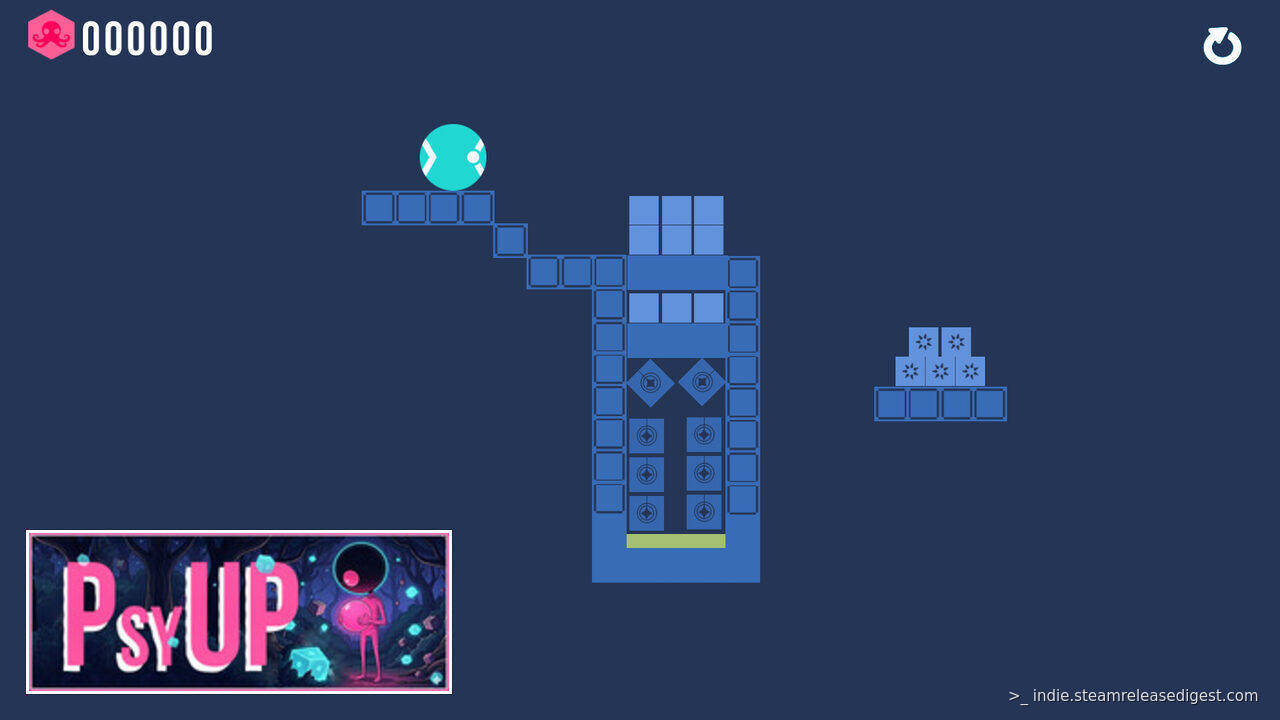
“Don’t let a few easy initial levels fool you,” one early player warns, capturing the unexpected difficulty shift at the heart of N2kStudio’s minimalist physics puzzler. On its clean surface, the title presents itself as a serene, stress-relieving space designed for breaking blocks and clearing inner clutter at your own pace. Beneath that calm visual aesthetic, however, lies a physics loop that quickly cranks up the challenge, paired with a heavy-handed psychological motif that leaves players questioning what breaking geometric blocks actually has to do with clinical mental health.
Order Out of Chaos
At its core, the interaction in PsyUp is straightforward and tactile. Built to be played entirely with a mouse and explicitly free from timed inputs, you are presented with minimalist structures made of colored blocks. Tapping a block destroys it instantly, triggering a cascade of physics interactions as remaining shapes shift, tumble, and collapse under gravity. The goal is simple: clear the screen, find the underlying pattern, and let the chaos settle into order.
The game attempts to frame these physics interactions around psychological states. Each stage sequence is inspired by human mental phenomena, attempting to give levels distinct “personalities”—arranging shapes to simulate the rapid instability of anxiety, the scattered chaos of ADHD, or the rigid, unyielding structures of perfectionism. Supported by clean visuals, custom audio controls, and an instant-reset feedback loop, it aims to act as a brief emotional breather during a busy day, letting players save anytime and work through stages without pressure.
Chilling Sounds vs. Baffling Themes
With an 86% positive rating across its initial wave of reviews, PsyUp succeeds for players looking for a quiet, low-cost puzzle fix. Steam reviewers repeatedly highlight the relaxing atmosphere, praising the game’s “chilling sounds” and clean presentation that make the simple act of destroying blocks feel tactile and soothing. Casual achievement hunters also appreciate its brief runtime, noting that it serves as an easy, satisfying game to complete 100% in under two hours. Furthermore, players who stick around past the deceptively simple opening stages find a surprisingly stiff physics challenge that forces real spatial problem-solving.
However, the game’s thematic foundation is precisely where player satisfaction begins to fracture. The decision to name levels directly after mental disorders is a central point of confusion across multiple reviews. Laymen and puzzle fans alike report an absolute disconnect between the gameplay mechanics and the clinical labels attached to them, with players left asking why the thematic connection exists at all if breaking a stack of blocks bears no observable link to the disorder in question.
Technical execution also draws sharp critique. Critical reviews highlight sporadic physics bugs and unrefined collision detection, arguing that the title feels more like an early alpha test than a fully polished product. When physics fail to behave consistently, players note that progression often devolves into tedious trial-and-error clicking rather than satisfying puzzle solving—leading some frustrated users to question how much intentional level design went into the project in the first place.
The Verdict
PsyUp: A Psychological Physics Puzzle works best if you ignore its loftier clinical ambitions and treat it purely as a low-cost, ambient physics distraction. If you want a $1.99 coffee-break game with smooth mouse controls, ambient audio, and a quick set of achievements to unlock, its block-busting loop provides a pleasant enough distraction. Just don’t expect a profound journey through human psychology, and be prepared to contend with a few physics glitches along the way.
Key Facts
- Developer: N2kStudio
- Publisher: N2kStudio
- Release Date: May 12, 2026
- Price: $1.99