Your opponent slides their Rook across the board, but it isn’t traveling alone. A tiny pixelated pawn is riding piggyback on top of it, hitching a ride via the “Rook Express” to land deep inside your territory. You move your Sage to capture the threat, only to trigger a hidden magical artifact tucked inside the pawn’s chest. Suddenly, your carefully planned defense evaporates. In this fantasy variant, every pawn is a literal treasure chest of hidden rules, and your opponent’s bluff just cost you the game.
Developed by Ancient Moai Cooperative, the game takes the ancient game of chess and wraps it in a cozy, pixelated shroud of fantasy and hidden-information mechanics. The most radical shift is the complete elimination of check and checkmate. Here, kings are simply captured like any other piece. Traditional bishops are gone, replaced by Sages and Sorcerers, and players can win through two distinct victory conditions rather than just one.
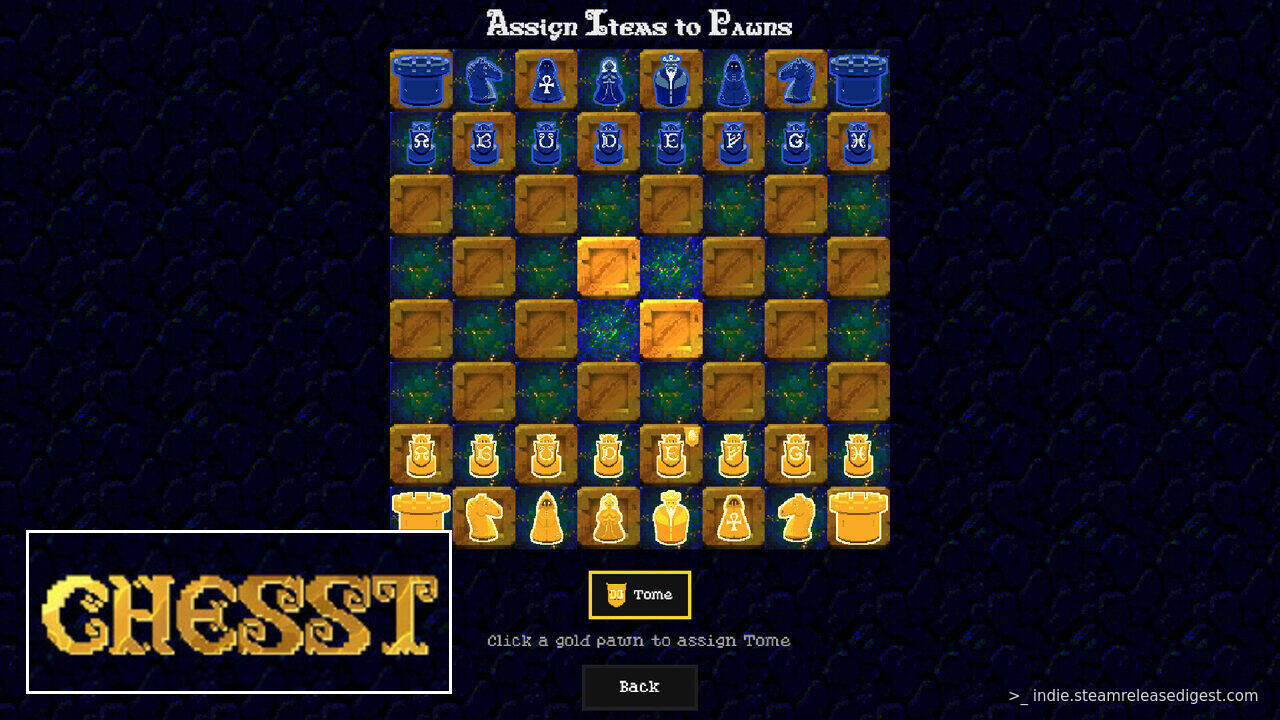
Before a match begins, players visit the Magic Item Mart. Here, you can secretively equip up to three of your pawns with one of seven distinct magical items. Because your opponent cannot see which pawns are armed and which are ordinary, the opening phase of the game transforms into a psychological battle of bluffing and deduction. Only you know which chests are empty and which carry mighty secrets. To add to the tactical chaos, pawns can hitch rides on Rooks to cross the board instantly, and players can work toward hatching dragons or transforming pesky enemy threats into harmless unicorns.
A Delightful Twist with a Learning Curve
With its warm, nostalgic 2D pixel art and a soundtrack players describe as “chill and regal,” the game cultivates a surprisingly cozy atmosphere for a competitive strategy game. However, early player feedback highlights a crucial friction point: you cannot play this like traditional chess. Those who skip the rules and jump straight into a match find themselves utterly bewildered by how pieces move and interact. The replacement of bishops with the Sage and Sorcerer, in particular, completely upends traditional board control and can frustrate players who expect standard FIDE rules.
Thankfully, the developers have included an easy-to-follow, graphic-heavy in-game guide to ease the transition. Players who take the few minutes required to read it find a deeply rewarding and balanced experience. The magical buffs do not make matches overly easy or chaotic; instead, they are offset by nerfs to other standard pieces, keeping matches tight and strategically diverse. Furthermore, with millions of potential starting configurations, the game actively prevents players from relying on memorized opening book moves, leveling the playing field for newcomers and veterans alike.
Designed primarily as a local experience, the game relies on pass-and-play multiplayer. There are no online matchmaking lobbies or strangers here; it is built for sharing a screen across a couch, a kitchen table, or a quiet café. For solo players, a built-in AI offers three distinct difficulty tiers named Jester, Bard, and Wizard, allowing you to test your strategies in private before springing your traps on a friend.
The Verdict
This is not a game designed to appeal to rigid chess purists who crave the predictable, centuries-old calculus of the classic game. Instead, it is a delightful, mischievous reimagining built for casual strategy fans, local co-op gamers, and players who want to inject surprise, bluffing, and cozy fantasy aesthetics into their tactical matches. If you are willing to spend five minutes reading the rulebook before making your first move, you will find a remarkably clever strategy game that turns familiar patterns on their head.
Key Facts
- Developer: ANCIENT MOAI COOPERATIVE
- Publisher: ANCIENT MOAI COOPERATIVE
- Release Date: May 8, 2026
- Price: $9.99