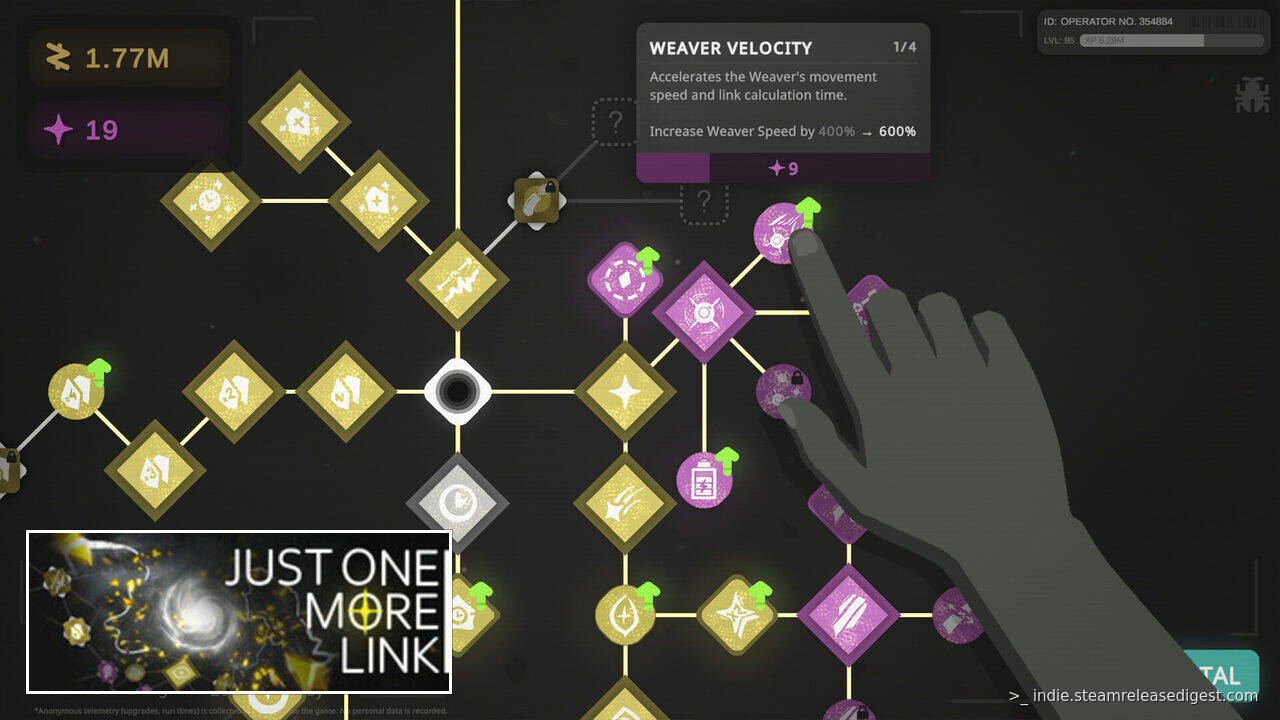
The timer is ticking down toward zero, and you are greedily dragging a line across a cluster of glowing crystals. You know you should release the mouse button and secure your payout, but the urge to snag one more node is paralyzing. You stretch the chain just a millimeter too far; it snaps with a crisp, tactile shudder, the clock hits 0.00, and your entire run’s earnings vanish. This high-wire act of greed and risk is the mechanical heartbeat of this unique incremental roguelite, a game that weaponizes your own lack of self-control against you.
The core loop is built around a stressful, pay-to-play economy. Before you even begin a run, you must purchase your time on the clock using Zek, the game’s primary currency. Because the cost of this time scales exponentially, each run begins as a literal wager: you must earn more than you spent just to stay afloat. Once the clock starts, the game becomes a frantic, mouse-only harvest. You click and drag to connect crystals, creating massive, screen-clearing chain reactions and lasers. The physics here are remarkably snappy and tactile, completely avoiding the floaty, sluggish feel common to lesser physics-based games. The longer your chain, the higher your exponential profit multiplier climbs. But because the chains have physical weight and instability, stretching them too far results in an instant snap. Anything you successfully cash in before the timer expires is invested back into a sprawling Constellation Tree, where you can buy upgrades like increased grab sizes, greed multipliers, and entirely new resources.
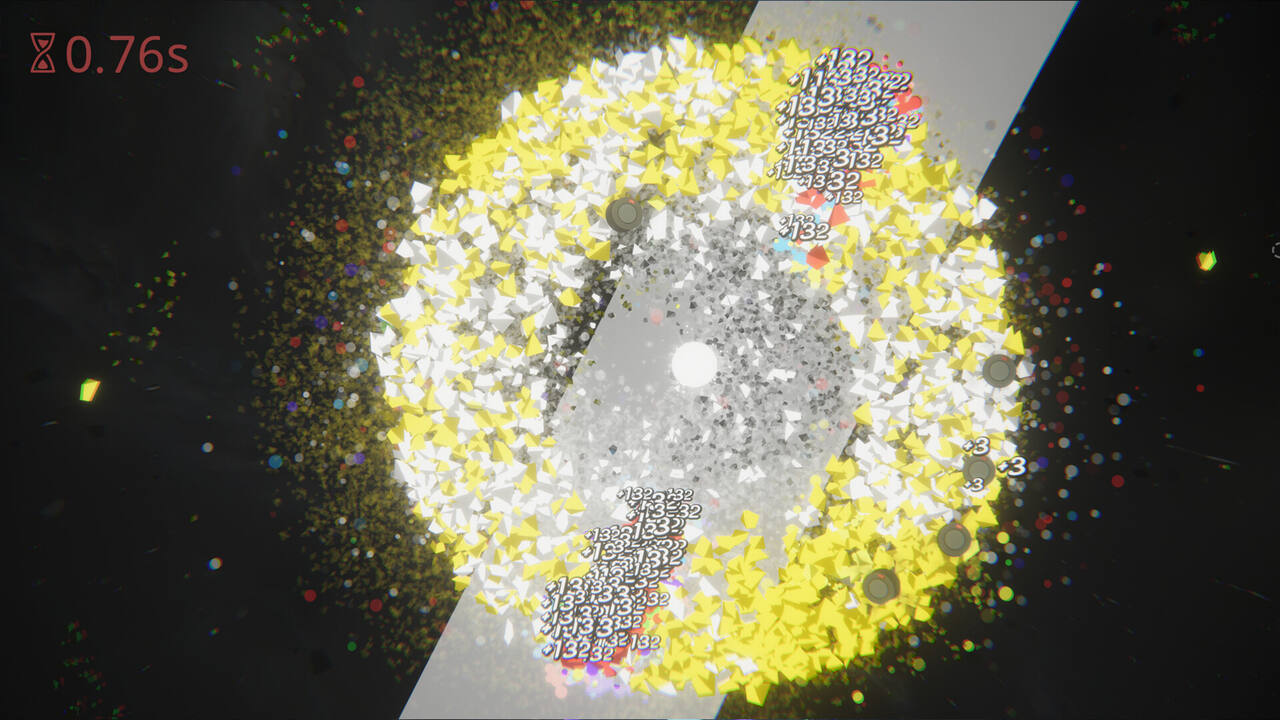
Steam players have responded with absolute delight to this kinetic loop, praising its flashing, clean visuals and highly addictive quality. It is a game that perfectly captures the “one more run” mentality, with some reviews describing it as a beautifully chaotic, ADHD-fueled experience. The sense of progression is initially incredibly satisfying, as the talent tree opens up new mechanics and currencies that change how you approach the board, offering a surprising amount of depth for the price.
However, the community is equally vocal about the game’s rougher edges. The primary criticism lies in its late-game pacing. While early progression feels meaningful, the endgame arrives in a sudden, dizzying rush. Several players noted that newly unlocked currencies, each with their own unique mechanical gimmicks, are utilized for only three to five minutes before becoming completely obsolete. An abrupt, absurd profit spike in the main currency, Zek, effectively trivializes the challenge late in the game. Furthermore, there are minor bugs to contend with, and some players expressed frustration with the tutorial delivery, wishing for an option to disable instructions entirely and figure out the game’s oddities—like a certain purple bastard of an NPC—on their own. There is also a quiet consensus that the price point is a bit steep compared to some of its more bloated, spreadsheet-heavy genre competitors, despite the sheer quality of its core mechanics.
Ultimately, this is a game for players who want their incremental progression delivered with a shot of adrenaline and a highly tactile feel. If you are looking for a passive, slow-burn idle game to run in the background, this is not it. But if you want a fast, flashy, and intensely rewarding strategy game that makes every second feel like a high-stakes gamble, it is well worth your time. It may peak too early and suffer from pacing issues in its final hours, but the journey to get there is an absolute blast.
Key Facts
- Developer: Blagine
- Publisher: Blagine
- Release Date: Jun 4, 2026
- Price: $6.99