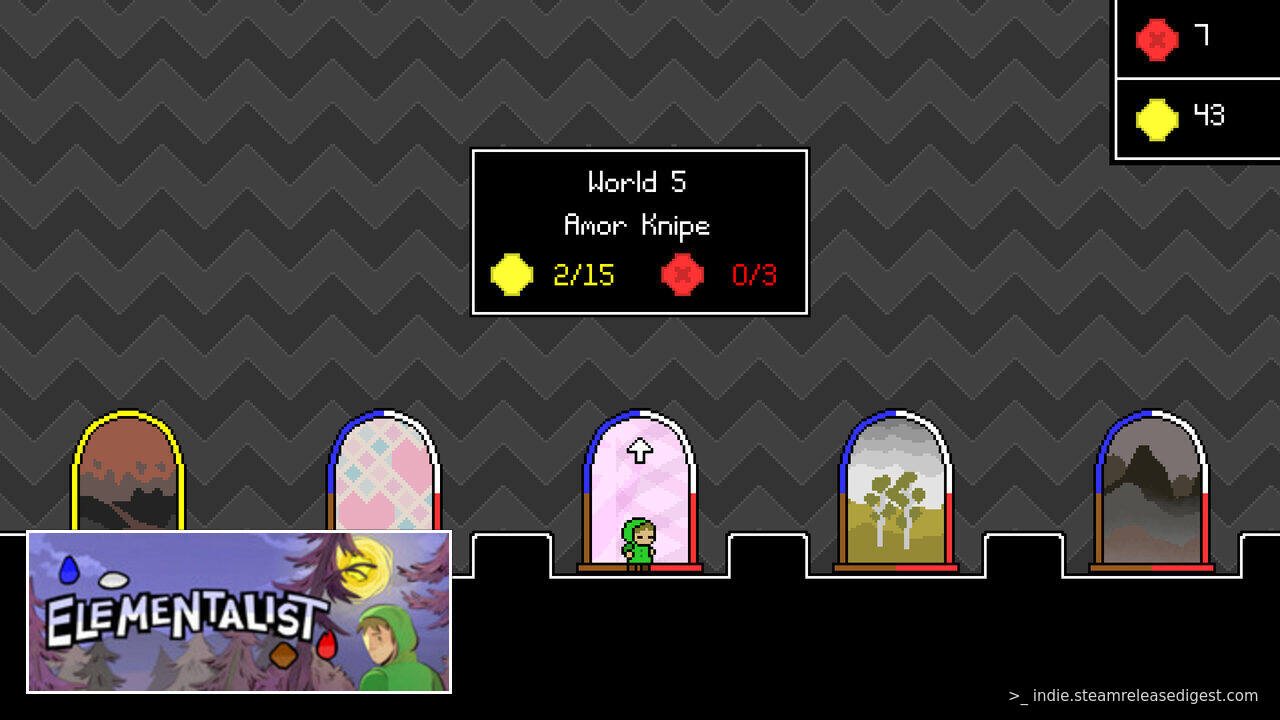
In Elementalist, platforming is stripped of twitch reflexes and rebuilt as a strict sequence puzzle where grabbing a double-jump, dash, or teleport orb locks you into using that exact ability next to navigate a treacherous room.
You play as Zoe, an adventurous young Elementalist who wakes up in a strange, sprawling library after a teleportation accident. To help her find her way home, you must guide her through a series of peculiar worlds. However, you cannot simply run and jump your way to the exit of each screen. Instead, you must collect movement abilities in a strict “Elemental Stack” that is deployed one by one. Your goal is to work out the exact route required to retrieve a sun fragment and safely carry it back to your starting portal, using only the limited toolbox the level geometry allows.
The core gameplay is a delicate dance of spatial resource management. The levels are tight, geometric rooms filled with classic platforming power-ups—including horizontal dashes, double jumps, ground slams, and teleportation shots—scattered as floating orbs. The catch is that your stack operates on a rigid order of operations. If you pick up a dash and then a double-jump, your very next button press must be the double-jump. The platforming elements here are not meant to test your reaction times; instead, they serve as physical obstacles. The game forces you to route your movements around gravity, jump distance, and momentum, turning a traditional action genre into a pure cerebral exercise.
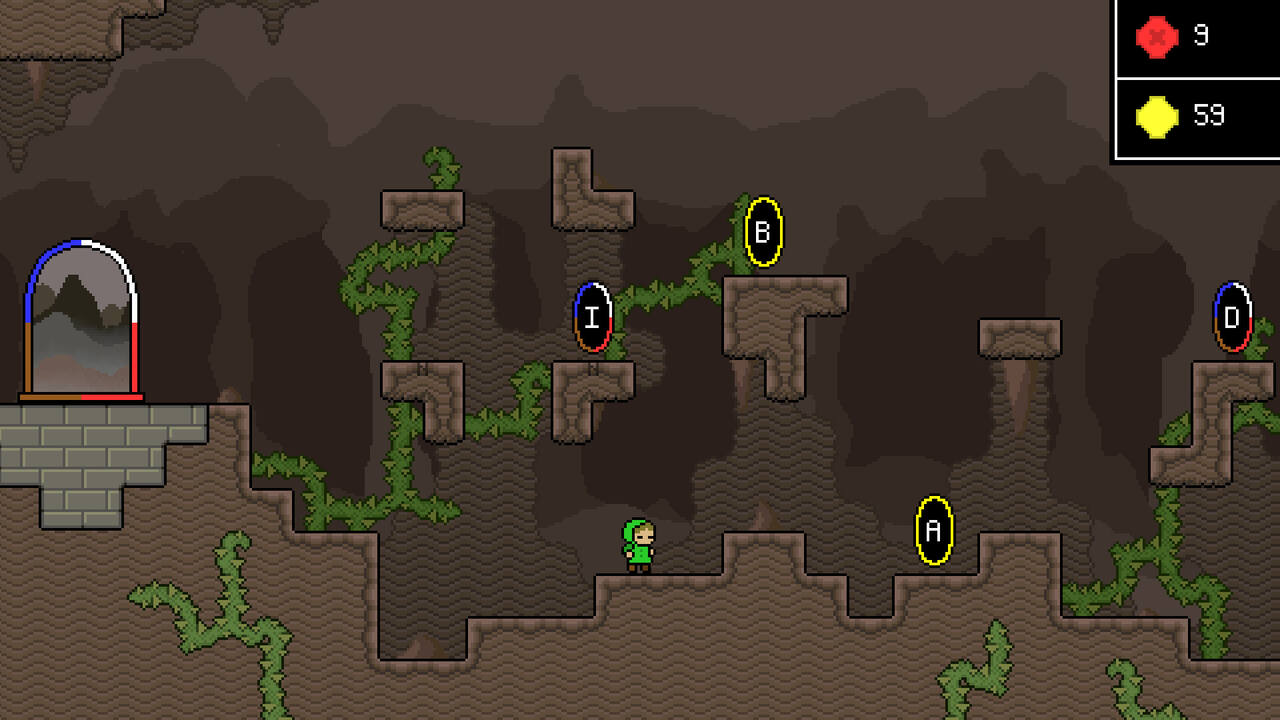
According to its players—who have given the game a flawless 100% positive rating on Steam—the level design is exceptionally tight and rewarding. Players praise Elementalist as a stellar entry in the sequencing puzzle subgenre, drawing comparisons to logic-heavy platforming titles like I wanna lockpick and the intricate, momentum-routing challenges found in modded Celeste. The sheer satisfaction of making logical inferences is the game’s greatest strength. When you finally deduce a solution, it often relies on a brilliant “outside-the-box” trick that leaves you marveling at how simple the answer was all along, even if you spent twenty minutes staring blankly at the screen to find it.
However, that uncompromising logic means Elementalist is designed to trick you, which can occasionally cause some friction. This is a game where the most obvious, intuitive path is almost always a designed trap meant to lead you into a fail state. For some, this constant subversion of expectations can feel exhausting, especially when tackling the highly challenging optional “S-puzzles” that require wild lateral thinking. While the developer has included a helpful hint system to keep you from getting permanently stuck, the puzzle design can occasionally polarize; one player noted that while almost all of the lateral challenges are brilliant, an occasional room can feel slightly lackluster compared to the stellar design of the rest. Furthermore, the game features deeply integrated meta-puzzles—particularly in World 6—which will delight fans of secrets but might frustrate players who prefer straightforward grid-based logic.
Ultimately, Elementalist is a game for players who love spatial reasoning, routing puzzles, and games that respect their intelligence. If you want a platformer that tests your thumb speed, look elsewhere. But if you want to trade raw reflexes for pure logic, this finely tuned $8.00 indie is an absolute must-play.
Key Facts
- Developer: Dawid Maziarski
- Publisher: Dawid Maziarski
- Release Date: Jun 3, 2026
- Price: $8.00