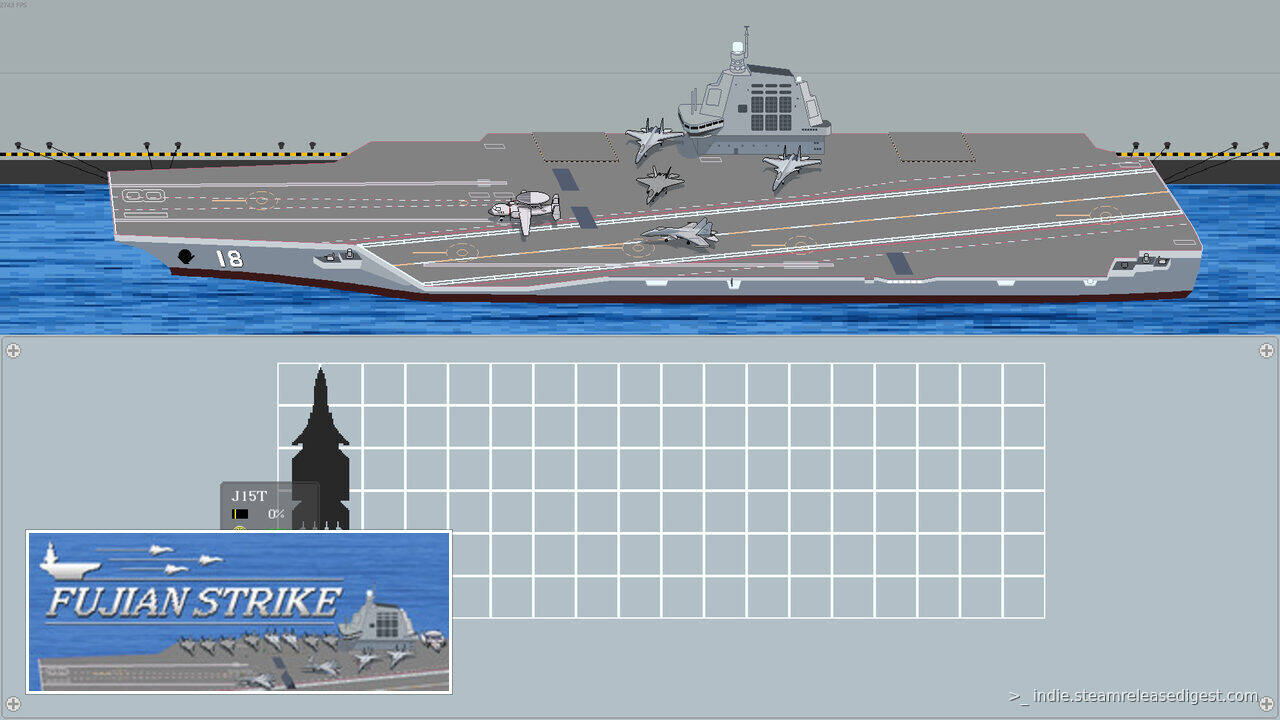
You are standing on the 2D pixel-art flight deck of the Fujian, China’s third aircraft carrier, watching a fighter jet stall out because you forgot to clear the arresting cables. At its budget price of $6.99, you might expect FuJianStrike to be a breezy, passive idle game where you occasionally click to watch planes take off. Instead, solo developer Mithril_055 delivers a high-tension, fast-paced time management simulator that demands rapid-fire tactical decisions. It is a game that deliberately punishes hesitation, forcing you to run a highly coordinated military flight deck where five minutes of indecision can cost you the entire fleet.
The Chaos of Carrier Operations
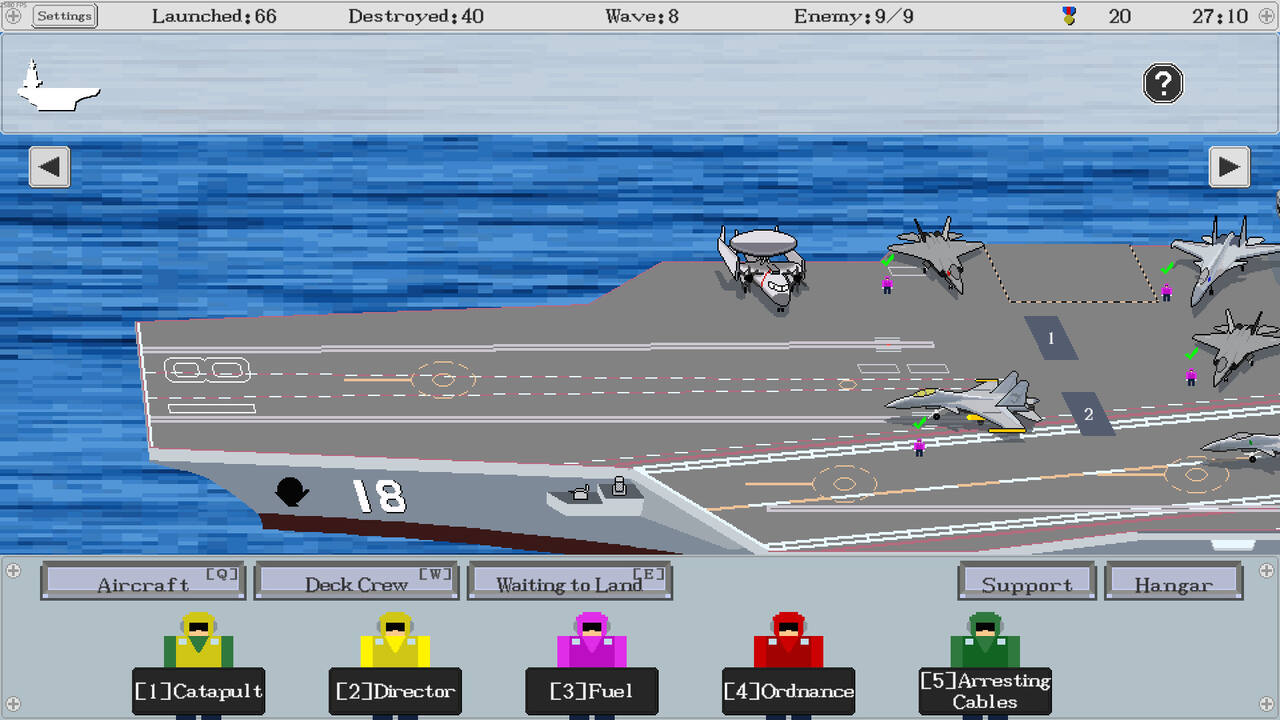
The gameplay of FuJianStrike centers on the frantic, highly complex dance of carrier deck scheduling. As a member of the ground crew, your job is to prepare fighter jets for intercept missions before oncoming waves of enemies overwhelm your ship. This requires manual control over the entire logistical chain. You must taxi aircraft to their designated spots, manage their refueling pipelines, select and mount specific ammunition loadouts to counter diverse enemy threat profiles, and safely guide them through launch and landing sequences.
The game structured its challenges across a 4-chapter campaign featuring 26 alternate history combat missions. These levels act as an extended tutorial, gradually introducing you to a deeper tech tree that unlocks advanced weaponry and upgrades for your aircraft. The campaign tasks you with protecting special friendly units while fending off increasingly aggressive enemy forces. Once you survive these scripted encounters, the game opens up into three different difficulty levels of endless mode, testing exactly how long you can sustain operations against infinite, unrelenting waves of hostile units.
What Players Love (And What Frustrates Them)
Among players, FuJianStrike has carved out a dedicated following due to its incredibly rare subject matter. It stands out as one of the very few modern military simulators to tackle a fictional conflict relating to Taiwan, and it enters a “carrier commander” subgenre that is historically starved for new releases. Players praise the sheer satisfying pressure of juggling weapons and loadouts on the fly, finding that the game requires real tactical skill despite its seemingly simple 2D pixel-art presentation. The consensus is that the developer has significantly undervalued their work, with reviews noting that the deep tactical loop is easily worth more than the current asking price.
However, running a flight deck by hand can wear on your patience. Players have pointed out that the core loop can become highly repetitive over longer sessions. Because every action must be triggered manually, some of the micro-management begins to feel like busywork. Several reviews express a strong desire for quality-of-life upgrades—such as automatic cable management or automated refueling options—to smooth out the late-game chaos. The difficulty is also unapologetically steep; it will comfortably “kick your ass” if you lose track of your queues, and military buffs have jokingly lamented that they cannot launch iconic Western fighters like the Tomcat from the carrier’s deck.
The Verdict
FuJianStrike is a highly focused, budget-friendly simulation built specifically for players who find genuine joy in high-stress logistics. If you love military hardware, modern warfare scenarios, and the frantic multitasking of time-management games stripped of their cartoonish whimsy, this is an easy recommendation. It may lack the massive scale of a 3D simulator, but its mechanical depth and tight design make it a standout title for anyone willing to master the chaotic art of flight deck command.
Key Facts
- Developer: Mithril_055
- Publisher: Mithril_055
- Release Date: Jun 2, 2026
- Price: $6.99