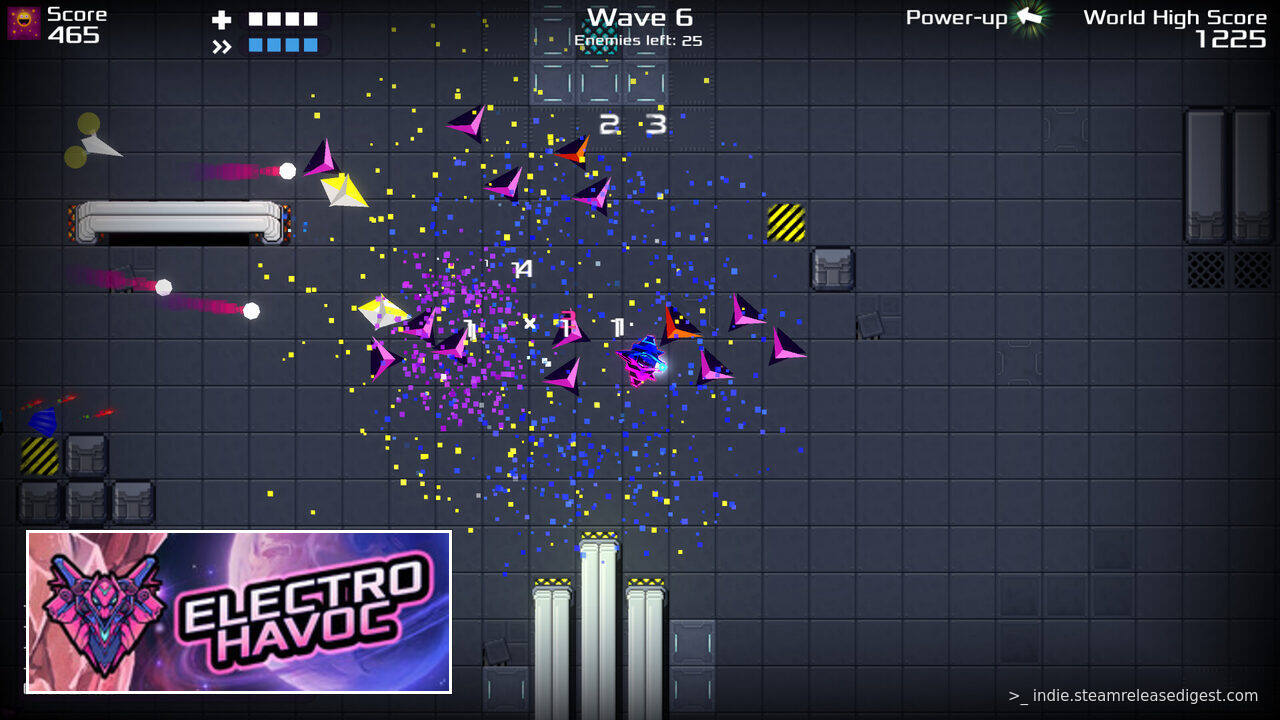
Electro Havoc turns the glowing wreckage of your fallen enemies into your most lethal weapon.
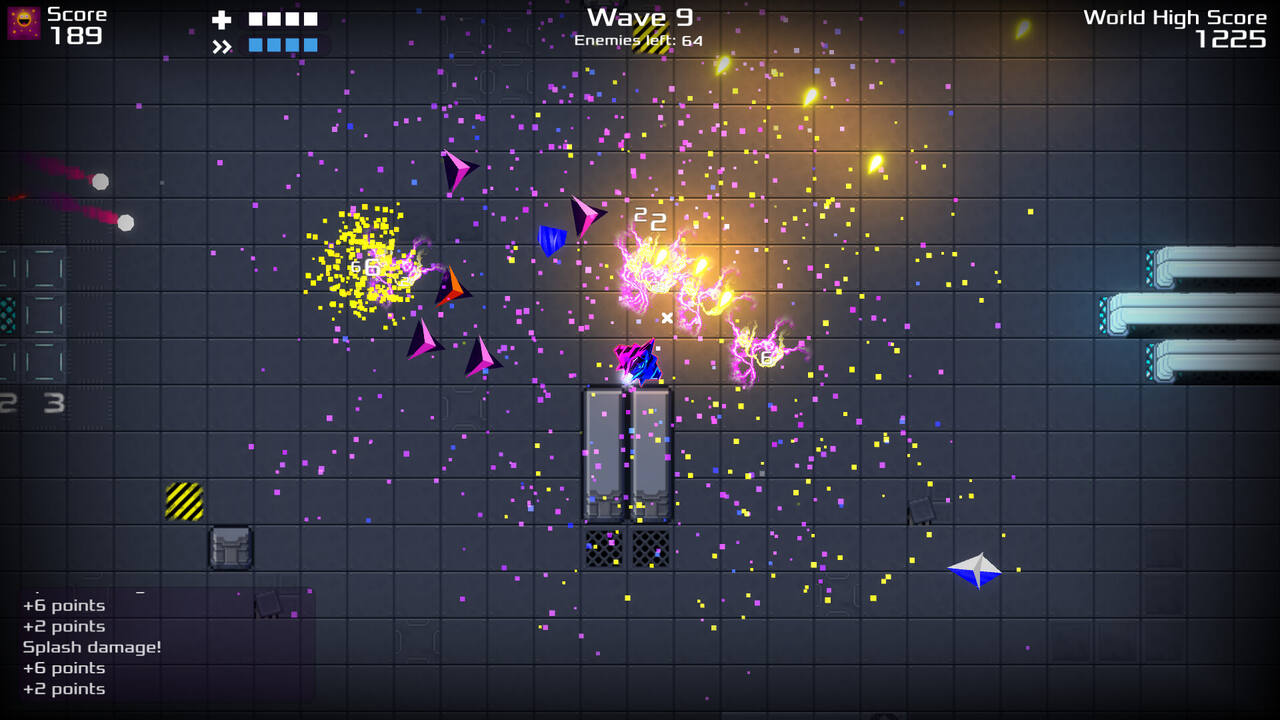
Developed and published by Ryan Matthews, this retro twin-stick shooter takes the familiar arena-survival blueprint and injects it with a smart, high-stakes tactical layer. Instead of simply dodging and shooting until the screen is clear, you are constantly maneuvering to guide your geometric pursuers into the expanding debris fields left behind by their blown-up comrades. Doing so triggers devastating, screen-clearing chain reactions and skyrockets your score multipliers. It turns a standard space dogfight into a tense game of kinetic billiards, where your positioning is just as dangerous as your actual lasers.
The Kinetic Flow of Geometry War
At the center of this neon-charged storm is the Starfighter X-7, a highly responsive combat ship tasked with surviving waves of abstract, geometric foes across three distinct worlds. The game’s minimalist enemy design dictates exactly how you must move. Shards are pointy, aggressive pests that scale up in size, speed, and attack patterns as the waves climb. Tetras are sturdier flight-path strikers that always come at you from awkward angles. Meanwhile, Quadgras prefer to keep their distance, pepper you with slow-moving projectiles, and force you to weave through tight gaps. Because these enemies behave so differently, survival isn’t just about holding down the fire button; it is about prioritizing targets and leaving debris fields in strategic choke points.
To help you navigate this chaos, the arena occasionally drops offensive and defensive power-ups that can quickly turn the tide of a bad run. On the offensive front, the Tri-blaster offers a wide, spray-and-pray pattern perfect for clearing out swarms, while the Mega blaster boosts your rate of fire with massive, heavy-hitting projectiles that shred through the toughest foes. On defense, you can grab shields for a brief moment of invulnerability, health regenerators to patch up your ship, or a thrust boost to jet out of tight corners. In a helpful touch of sensory design, the game provides a clear audible cue when these power-ups are about to expire, giving you a fair warning to stop playing aggressively and pull back before you are left defenseless in a crowd of enemies.
What the Players Are Saying
With an 88% positive rating on Steam, Electro Havoc has carved out a small but highly enthusiastic audience. Players are particularly fond of its striking presentation, with one reviewer noting there is “so much neon, I can hear colors.” The game’s clean, minimalist aesthetic and vibrant pixel particles make the screen feel alive with energy without becoming completely unreadable during high-intensity moments. Others have praised it as a shining example of what solo developers can achieve with the Godot engine, celebrating its smooth performance, full controller support, and instant pick-up-and-play appeal that makes it a great way to kill some time.
However, the game’s simplicity is a double-edged sword. While most players enjoy it as a casual, engaging arcade ride, some feel that it lacks the depth of more established titles in the twin-stick genre. One critical reviewer noted that while the game is perfectly fine, it does not do enough to truly stand out, grading it as a “C” and suggesting that it feels a bit too lightweight. If you are looking for deep progression systems, ship customization, or an epic narrative campaign, you won’t find them here. This is a pure, distilled arcade experience, for better and for worse.
The Verdict
Electro Havoc is a focused, budget-friendly arcade shooter that knows exactly what it wants to achieve. It does not reinvent the wheel, but its chain-reaction debris mechanic adds a welcome layer of spatial strategy to the classic twin-stick formula. If you have a soft spot for high-score chasing, vibrant neon aesthetics, and quick-fire gameplay sessions, this is an easy recommendation at its $5.99 price point. Just don’t expect a massive, genre-defining epic—this is a sleek, satisfying bite of retro action designed to be played in short, intense bursts.
Key Facts
- Developer: Ryan Matthews
- Publisher: Ryan Matthews
- Release Date: Jun 6, 2026
- Price: $5.99